

Cuban Style Cigar Bands: History, Design, and Enduring Legacy
Cuban style cigar bands are instantly recognizable: rich with gold foil, embossed details, heraldic symbols, and a visual language that speaks of heritage, prestige, and craftsmanship. This article explores the history, design characteristics, and lasting influence of Cuban style cigar bands.
The Origins: A Tale of Legends and Practicality
The invention of the cigar band is shrouded in myth. One popular legend attributes it to Russian Empress Catherine the Great, who supposedly ordered her cigars wrapped in silk to protect her fingers from tobacco stains. Another tale suggests that paper bands were first used on Havana cigars exported to England so that gentlemen would not stain their elegant white gloves. As charming as these stories are, cigar historians dismiss them as fanciful. Cuban historians, for instance, find it improbable that a Cuban manufacturer would have added expense to his product merely to keep an English dandy's gloves clean.
The true origin is more pragmatic. Modern historians credit a Dutch-born cigar maker named Gustave Bock with inventing the cigar band in Cuba during the 1830s. Bock, a European immigrant familiar with the deceptive practices of Old World merchants, ordered paper rings bearing his signature to be placed on every cigar intended for export to Europe. He believed this would lend an indication of quality and prestige to his products while simultaneously protecting them from counterfeits.
The idea caught on quickly. By the middle of the 1850s, virtually all Cuban cigar makers with significant exports were banding their cigars, registering their bands with the government, and advising consumers to insist on banded products. The band had evolved from a novelty into a necessity—a badge of authenticity in an increasingly competitive marketplace.
The Golden Age of Cigar Art
The turn of the 20th century marked the heyday of the cigar industry. An estimated four out of five American men smoked cigars, with production taking place in hundreds of factories. In this fiercely competitive environment, product differentiation became critical. With the cost of producing cigar bands at approximately 70 cents per thousand, colorful maker's marks became an essential tool for building brand identities. Historians estimate that roughly 2 billion cigar bands were sold in the United States in the year 1900 alone.
It was during this period that Cuban cigar bands truly became an art form. Chromolithography—the process of printing in multiple colors—arrived in Cuba in 1861. Once local technicians were trained, production was enormous. A particularly close relationship developed between the tobacco industry and chromolithographic printers. Everything from the largest posters to the smallest cigar bands was printed and embossed in elaborate multicolor designs. The bands and box art produced from 1890 to 1920 are today considered products of the "Golden Age" of cigar-related artwork.
Design Characteristics of Cuban Style Bands
What distinguishes a Cuban style cigar band from others? The answer lies in a combination of materials, techniques, and visual motifs that have become synonymous with the island's cigar heritage.
Paper and Construction
Genuine Cuban style bands are produced on a coated, slightly textured paper that takes color layers cleanly without bleed. When held against the light, an authentic band is opaque; counterfeit stock is often thinner, more translucent, or visibly fibrous along its cut edge. Authentic bands are die-cut, meaning the edges are sharp, even, and consistent from band to band. The reverse side of a genuine band is unprinted and clean, showing only a thin line of vegetable gum where the band closes.
Foil and Embossing
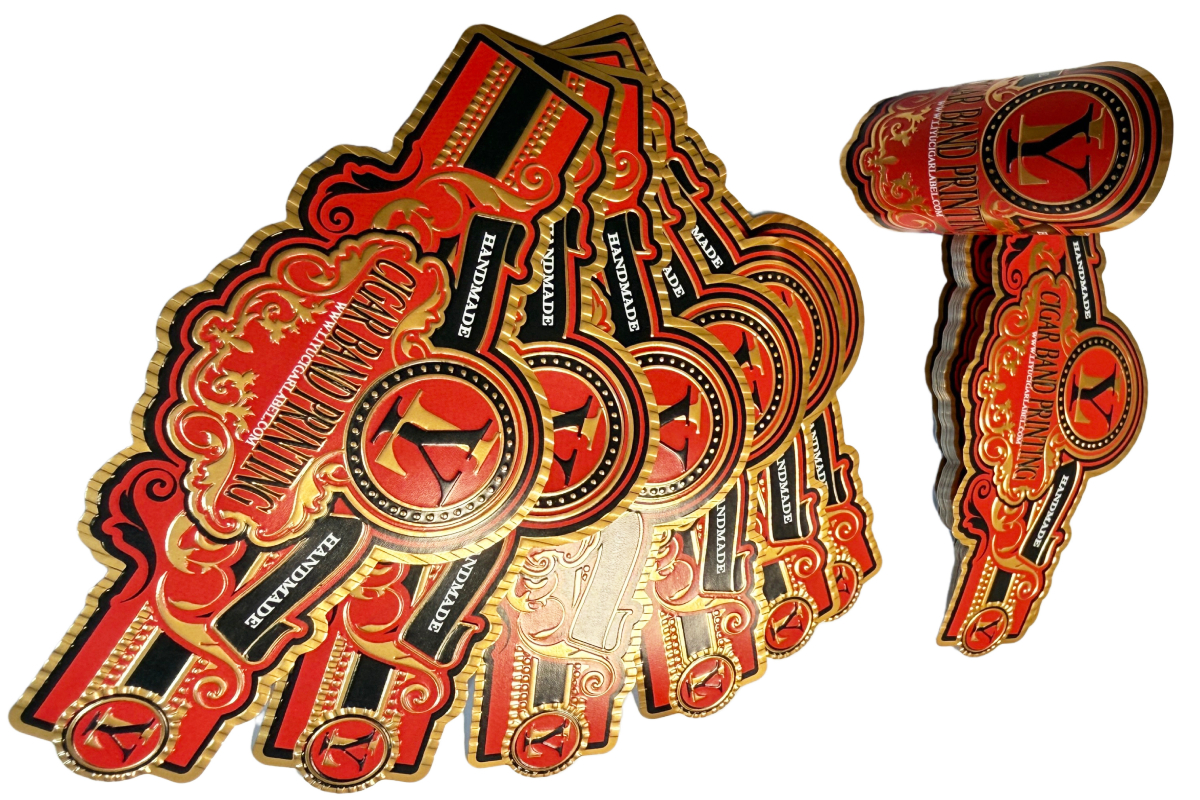
Perhaps the most defining feature of Cuban style bands is their use of gold foil and embossing. Real gold foil is applied as a metallic layer that reflects sharply and maintains its color from any angle. Embossing—the process of creating raised, tactile elements on the paper—is a hallmark of premium Cuban bands. Whether it is the fleur-de-lis on a Montecristo, the ornate crown on a Hoyo de Monterrey, or the coins flanking the logo on a Bolivar or Partagás, these raised details are not merely decorative—they are intentional security features. Flat-printed embossing—a printed shadow meant to imitate a raised edge—is a telltale sign of a counterfeit.
Color and Imagery
Cuban style bands are known for their rich, often regal color palettes. Gold and deep browns dominate many classic designs. The Montecristo band, for example, features a dark, bean-colored brown with squiggly gold lines, white borders, and a prominent gold fleur-de-lis at its center. The Bolivar brand features a gold-and-white motif with a prominent image of Simón Bolívar over a yellow background.
Imagery on Cuban bands often draws from heraldry, history, and national identity. Crests, coats of arms, royal symbols, and patriotic icons are common. These elements reflect the brand's essence and tell the story of each cigar, often reaching back through time to connect the people and places that have contributed to its legacy.
The Evolution of Iconic Brands
Some Cuban brands have seen dramatic band evolutions over the decades. Cohiba, perhaps the most famous Cuban cigar brand, has undergone one of the most extreme transformations. The earliest versions featured rows of white dots on a black background over the word "Cohiba," with a yellow stripe at the bottom. The dots soon became squares, and today's Cohiba bands feature sophisticated holographic compositions with embossed security elements. When the Cohiba Behike was launched commercially in 2010, its band alone was a technological innovation, encoded with holographic emblems specifically designed to thwart counterfeiters.
Montecristo has maintained its iconic fleur-de-lis—a symbol of French royalty, befitting the brand's namesake from Alexandre Dumas's novel—but the band itself has been refined over time. The fleur-de-lis became embossed in gold in 2013, and the brown shade deepened to a darker, redder bean color.
The Collector's Passion
Cigar bands have become serious collectibles. Dedicated collectors, organized into groups such as the International Label, Seal and Cigar Band Society, search out historical bands and hoard the bands of the cigars they smoke daily. For these enthusiasts, a cigar band is more than decorative packaging—it functions as a historical document frozen in time. Understanding the subtle changes in band design across different production eras can make the difference between a valuable find and a missed opportunity. Vintage Cuban bands from the early to mid-20th century are highly sought after, with collections of hundreds of bands fetching significant sums at auction.
Modern Interpretations and Custom Cuban Style Bands
Today, the aesthetic of Cuban style cigar bands continues to inspire manufacturers and brands worldwide. Custom cigar bands increasingly draw upon the visual language established by Cuban classics: gold foil stamping, embossed motifs, heraldic symbols, and rich color palettes. For businesses and individuals seeking to create their own premium cigar branding, Cuban style offers a template of sophistication and heritage that resonates with cigar enthusiasts globally.
Modern custom bands may incorporate advanced anti-counterfeit technologies such as holographic elements, unique serial numbers, and online authentication systems—innovations that echo the very purpose for which Gustave Bock invented the cigar band nearly two centuries ago.
The Etiquette Debate: To Remove or Not to Remove?
No discussion of cigar bands would be complete without addressing the enduring debate over etiquette: should the band remain on the cigar while it is being smoked? Some argue that removing the band allows the smoker to fully appreciate the wrapper and avoids the risk of the band tearing the wrapper when heated. Others insist that leaving the band on is a mark of respect for the brand and its craftsmanship. Regardless of one's position, the very existence of this debate speaks to the cultural significance of the cigar band—a small paper ring that commands such attention and passion.


